PLACES WITH A SOUND
Coastlines are not interchangeable stretches of water and rock. Each shore is defined by its exposed geological strata, orientation toward prevailing storm tracks, and offshore bathymetric contours.
A listener trained in environmental audio can place themselves on a map blindfolded simply by noting the reverberation time of headland echoes, the grain frequency of beach sediment, and the rhythmic regularity of incoming sets.
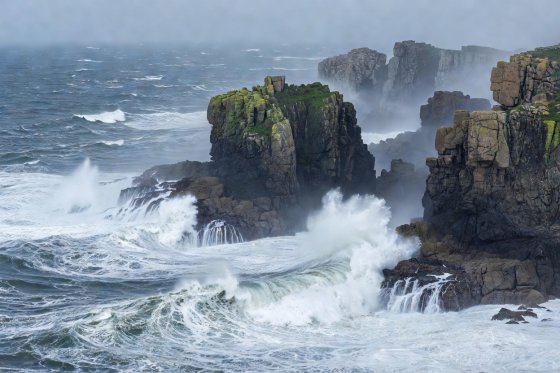
01 / BASALT HEADLANDS & SEA BLOWHOLES
Along the North Atlantic perimeter, ancient volcanic rock meets unhindered oceanic fetch. The defining acoustic feature here is the blowhole and sea cave network. When deep swell enters submerged tunnels, air is violently compressed into fissures, escaping upward with an echoing trumpet blast that can shake nearby turf.
Because these vertical cliffs act as giant acoustic reflectors, sound does not escape cleanly out to sea. Instead, the breaking crest bounces between opposing canyon walls, creating high reverberation times (up to 3.8 seconds) that turn sharp wave slaps into prolonged, cathedral-like drones.
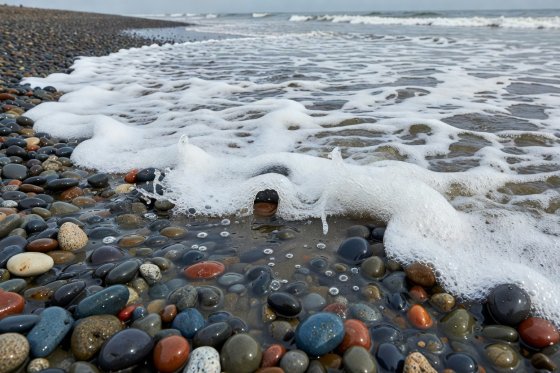
02 / THE CHURNING SHINGLE BEACH
Few soundscapes on earth match the percussive kinetic density of a steep shingle bank under six-foot swell. Unlike sandy shorelines where water infiltrates rapidly, smooth flint stones are lifted bodily by wave uprush and ground together as the surge retreats.
This generates a multi-layered acoustic event: the clean, wet crack of the initial impact, followed immediately by a prolonged, rolling murmur as tens of thousands of pebbles strike one another. In low-frequency recording terms, shingle banks eliminate the prolonged sub-bass hum of sand flats, substituting a dry, intense midrange texture.
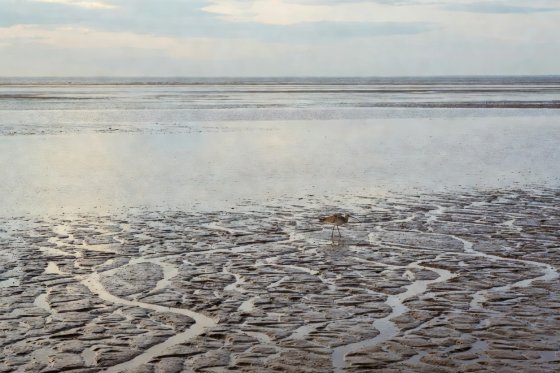
03 / TIDAL ESTUARIES & MUD FLATS
In wide, low-gradient estuaries, the ocean loses its focused breaking crest entirely. The soundscape becomes delicate, expansive, and deeply influenced by wind velocity across exposed tidal silts.
At high tide, gentle spilling ripples produce high-frequency clicks (4 kHz to 12 kHz) as micro-currents sweep over crab burrows and eelgrass blades. At low tide, the dominant audio shifts to the popping sound of thousands of tiny mud bubbles bursting as solar radiation warms the sediment, set against the calls of migrating curlews and oystercatchers.
04 / CORAL REEF BARRIERS & ATOLLS
A coral atoll acts as a sharp acoustic high-pass filter. On the outer barrier reef, thousands of miles of open Pacific swell encounter an abrupt vertical limestone wall that ascends from deep blue water in seconds.
The resulting crash is devastating in physical power, creating infrasonic vibrations that resonate through the solid coral substrate. Yet just one hundred meters inland, inside the protected lagoon, the water remains glassy and near-silent, save for the distant perimeter throb and the underwater grazing clicks of parrotfish gnawing at calcified algae.