HEAR THE BREAK
Every wave is a physical kinetic release of energy generated thousands of miles away by open-ocean wind storms. When that wave meets the ascending sea floor, that kinetic potential converts into hydrodynamics, heat, and sonic pressure.
Understanding how water forms an acoustic instrument allows coastal recordists and surfers to anticipate the power, shape, and danger of any swell without looking at a buoy graph.
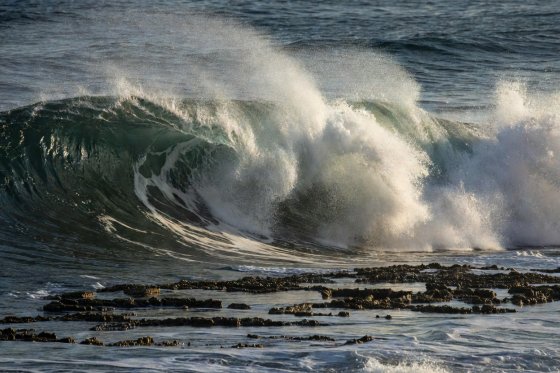
HOW A WAVE CREATES SOUND
A wave does not make noise simply because moving water touches itself. The overwhelming majority of the sound produced during a break originates from two distinct phenomena: cavitation impact and entrained bubble resonance.
As the wave crest pitches forward and impacts the water surface below, a hollow air pocket is enclosed. This trapped cylinder of atmospheric air is violently compressed by tons of falling seawater. The cylinder destabilizes into billions of micro-bubbles, each ringing like a struck chime at its own resonant frequency according to Marcel Minnaert's bubble formula.
The collective sum of these ringing bubbles creates the unmistakable roar of surf, ranging from deep low rumble to shimmering hiss.
THE THREE BREAKER TYPES
The gradient of the seabed determines how rapidly a wave stalls and pitches. This physical geometry directly shapes the frequency profile of the resulting soundscape.
| Breaker Type | Seabed Slope | Dominant Frequency | Acoustic Character | Surf Culture Context |
|---|---|---|---|---|
| Spilling Breaker | Gentle (1:40 to 1:100) | 1.2 kHz – 7.5 kHz | Continuous, wide-spectrum hiss with no single primary concussive punch. | Beginner longboard spots, gentle sandbanks, mellow tidal beaches. |
| Plunging Breaker | Moderate to Steep (1:10 to 1:25) | 45 Hz – 250 Hz | Pneumatic explosive crack followed by heavy sub-bass floor tremor. | Hollow tubes, fast reef barrels, shorebreak wedges (Pipeline, Teahupo'o). |
| Surging Breaker | Very Steep (> 1:8) | 15 Hz – 90 Hz | Deep hydraulic slosh against rock faces with high backwash collision slur. | Rocky headlands, cliff bases, non-rideable reflective slabs. |
THE ACOUSTICS OF RIDING THE TUBE
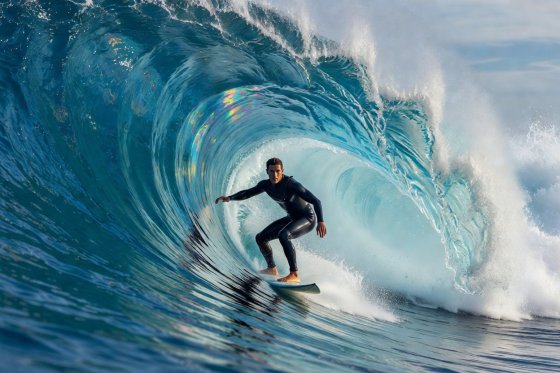
In surf literature, surfers consistently describe riding inside a wave's barrel as a transformative auditory event. The exterior ocean roar abruptly drops in amplitude, replaced by an eerie, hollow hum resembling a pipe organ or industrial intake chamber.
This perceptual phenomenon is acoustic reality. The cylindrical water curved over the rider acts as a high-pass acoustic filter and natural waveguide. The dense curtain of falling water insulates the inner cylinder from external wind and beach noise, while internal air vortexes generate localized low-frequency standing waves.
When the wave closes out, that compressed chamber spits out mist and air at velocities exceeding 40 miles per hour, producing a sharp high-velocity "whoof" that reverberates across the break.
SEDIMENT NOISE: WHAT THE WAVE DRAGS
The water’s fall is only half the sound. What happens when gravity pulls that water back toward the sea is equally critical to the coastal ear:
Silica & Quartz Fine Slur
On fine sandy shores, backwash yields a faint scraping hiss below 3 kHz, quickly drowned out by incoming breakers. Very low acoustic persistence.
Chipping Flint & River Stones
Steep cobble shores release an aggressive, clattering roar between 500 Hz and 4 kHz as thousands of stones roll over one another down the bank.
Carbonate Shards & Calcified Shells
Tropical reef margins produce high-frequency clicks and tinkles as calcified coral fragments roll across limestone plateaus.