BRING BACK THE ATMOSPHERE
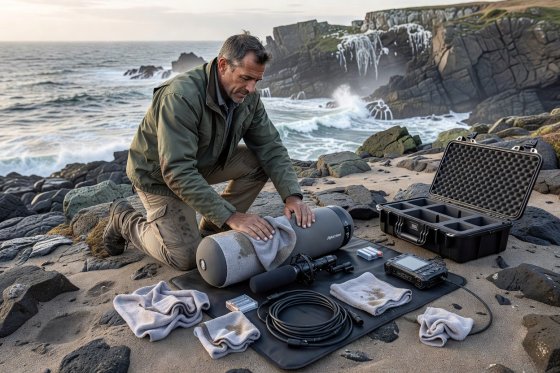
The coast is the most hostile natural environment for audio recording equipment. Relentless marine winds, blowing silica sand, airborne salt mist, and enormous dynamic range will ruin amateur attempts within minutes.
Capturing the genuine nuance of ocean swell demands an understanding of microphone physics, careful capsule protection, and calibrated stereo spacing that preserves spatial width without phase cancellation.
WIND DEFENSE: THE TRIPLE-LAYER RULE
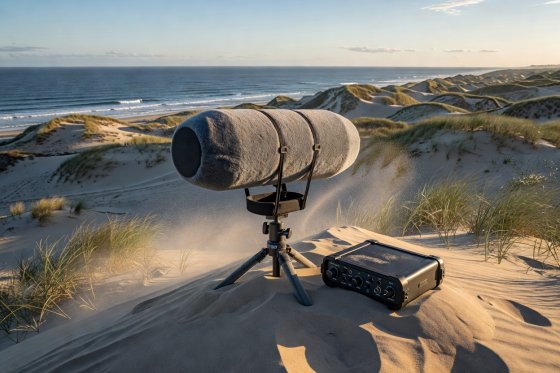
Ordinary foam covers fail completely when onshore gusts exceed 8 knots. Moving air causes massive pressure differentials directly across the sensitive microphone diaphragm, resulting in unusable low-frequency distortion and preamp clipping.
Experienced coastal acousticians rely on a three-stage mitigation system:
- Acoustically Transparent Cage (Zeppelin): An enclosed mesh blimp that establishes an area of stagnant air around the transducers.
- High-Density Synthetic Fur ("Deadcat"): Long, varied-length synthetic fibers that decelerate turbulent gusts before they strike the inner cage.
- Inner Open-Cell Foam Barrier: Secondary attenuation to kill residual micro-vortices.
Additionally, engaging a hardware analog 18 dB/octave high-pass filter at 40 Hz protects analog-to-digital converters from sub-audible wind rumble without sacrificing breaking wave impact.
SELECTING THE RIGHT STEREO ARRAY
The massive horizontal horizon of a beach requires an intentional stereo technique to avoid a hollow center or bloated phase smear:
Office de Radiodiffusion-Télévision Française
Two cardioid capsules spaced 17 cm apart at a 110-degree angle. Provides exceptional localization of individual wave peaks peeling across a point break.
Spaced Omnidirectional Pair
Two omnidirectional capsules spaced 40 cm to 1 meter apart. Omnis have far superior low-frequency extension and natural wind resistance, capturing deep swell rumble.
Mid-Side Configuration
One cardioid capsule facing forward combined with one bidirectional (figure-8) capsule facing lateral. Allows post-production adjustment of shoreline width and 100% mono compatibility.
SALT & SAND PROTOCOL
Salt aerosol is conductive and corrosive. A single day of shoreline recording without proper hygiene can ruin gold-sputtered condenser capsules and seize aluminum tripod leg locks.