ANOTHER ACOUSTIC WORLD
Human beings are deaf beneath the surface. Our outer ears are acoustically matched to the impedance of air; when submerged, sound waves bypass our eardrums and conduct directly through our skulls, destroying our ability to localize direction.
Drop a piezoelectric hydrophone into the water column, however, and a hidden acoustic realm emerges: crackling snapping shrimp, whistling cetaceans, and the heavy low-frequency vibration of waves breaking overhead.
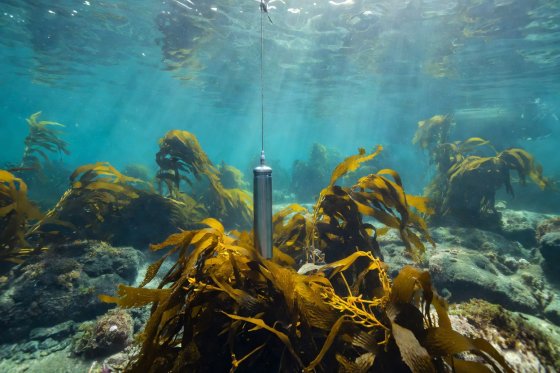
HOW HYDROPHONES HEAR WATER
Standard microphones utilize an extremely lightweight diaphragm that vibrates with air pressure differentials. In water, where the density is roughly 800 times greater than air, such diaphragms become immobilized.
Hydrophones solve this using piezoelectric ceramics (such as lead zirconate titanate). When physical pressure waves in the seawater compress the ceramic crystal, it generates a proportional micro-voltage directly. Because water is nearly incompressible, these acoustic waves pass directly into the transducer without acoustic reflection.
Furthermore, because sound moves at approximately 1,500 m/s in saltwater compared to 343 m/s in air, sound wavelengths underwater are more than four times longer for any given pitch.
PRIMARY VOICES OF THE SHALLOW REEF
The underwater soundscape is dominated not by silence, but by continuous biological activity that peaks at dusk and dawn:
Snapping Shrimp (Alpheidae)
The universal frying-pan crackle of shallow temperate and tropical seas. When their rapid claw closure collapses a cavitation bubble, local temperatures momentarily match the sun's surface, releasing an impulsive click up to 210 dB.
Urchin Grazing (Echinometra)
Along rocky temperate reefs, millions of sea urchin teeth scraping kelp holdfasts and calcified surfaces generate a resonant ringing between 800 Hz and 2.5 kHz.
Coastal Delphinids & Odontocetes
Bottlenose dolphins and harbour porpoises utilizing high-repetition echolocation clicks and frequency-modulated tonal whistles to navigate the surf zone and hunt baitfish.
PREVENTING CABLE STRUM
The single greatest operational hazard in underwater audio recording is cable strum. When tidal currents or surf surge push against the hanging hydrophone lead, the cable vibrates like a plucked bass string, transmitting severe mechanical rumbling directly into the sensor housing.
To eliminate strum, acousticians never hang a sensor directly from a floating surface buoy without decoupling. Employing an elastic shock tether, adding streamlined lead sinkers, or securing the sensor to a fixed bottom anchor keeps the transducer isolated from hydrodynamic vortex shedding.